
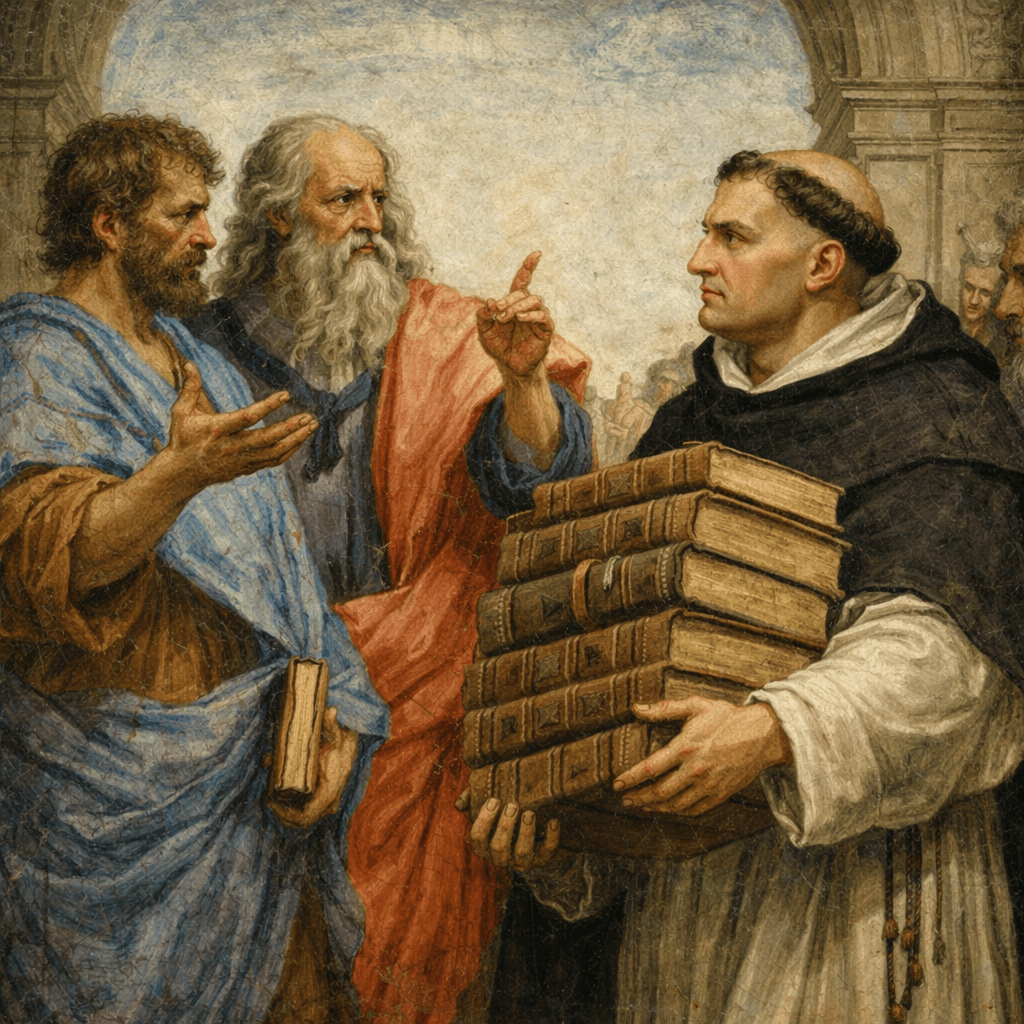
Two Operating Systems: Athens and Jerusalem
After reading Peter Leithart’s article, “Aristotle’s Teleology: Craft and Theology in Aristotle,” I found myself almost completely unable to make sense of it. Of course, if I had spent years studying philosophy and learning its history and technical vocabulary, I’m sure I would have done better. Still, one line at the very end was perfectly clear:
“Again, a neat trick: Order and purpose in nature; nature closely resembling craft; all in a theistic universe in which everything desires and strives toward god. Yet he achieves all of this without positing immanent gods or even demi-divine intelligences. Elegant, neat, and, of course, utterly incompatible with Scripture.”
On that one point, I agree entirely: this is utterly incompatible with Scripture.
Reading this article pushed me to a simpler conclusion—the real problem is Aristotle. I do not want to be an Aristotelian. I do not think the Bible speaks this way. Maybe Tertullian was right after all: “What has Athens to do with Jerusalem?”So much Christian theology has been built using an alien operating system rather than the Bible’s own native grammar. Scripture does not presuppose the conceptual machinery the Greek philosophers constructed.
Paul’s judgment on philosophy is blunt: “For the wisdom of this world is folly with God” (1 Cor. 3:19). What if we actually took that as our axiom? What if we returned, not to Aristotle’s categories, but to the Bible’s own operating system: “In the beginning, God created the heavens and the earth”? This is a statement of fact without explanation. The Bible tells us what God does and what He is like, but it does not explain Him or invite us to peer behind the curtain.
The scope of the revelation given by Scripture is restrained by design. The meaning of Scripture is one and not open to endless speculation. It is perspicuous, not esoteric—given to be heard and understood but not decoded by an elite class. To press beyond the plain sense of Scripture is not faithful exegesis but a gnostic impulse, a search for hidden mechanisms where God has given us His words and works instead.
If the meaning intended by Scripture is one, then what may be deduced by good and necessary consequence must also have a limit. Not everything that can be deduced from Scripture is therefore true, nor does Scripture invite us to treat deduction as an unlimited engine of meaning. The Sadducees, for example, had arguments drawn from Scripture for denying the resurrection, yet Christ rebukes them precisely because their reasoning, however coherent, went beyond what the text intended to teach. Their error was not a failure to reason, but a failure to submit their reasoning to the scope and purpose of Scripture itself.
What follows is an attempt to explain that simpler, cleaner, Biblical OS or as I call it Jerusalem OS. To understand this OS, we must first look at the Aristotelian OS or as I call it the Athens OS.
The Theistic Proofs of God
Thomas Aquinas, the Doctor of the Roman Catholic Church—and the one who, more than anyone, brought Aristotle into Christian theology as an organizing philosophical principle—constructed a Natural Theology based on reason and Aristotelian logic. He offered the famous rational proofs for God and posited that God is the “unmoved mover” in a causal chain of origins. God, in his system, was seen as the First Cause.
Using the word system is a tell. God is not to be thought of as a cog in a system. He is the Creator of all systems but is not in the system itself. To bring God down to our level and argue in such a manner is to forget the Creator–creature distinction. He is the living God and not part of creation.
Properly speaking, God does not cause anything. He simply creates. The word simple is intentional here. God’s acts are without parts, composition, or division—they are simple. If we think of God’s power as acting through a causal chain, we divide His being. Power cannot be separated from His being. God is one. He simply is. He is not composed of attributes as parts. He is the great I AM. Properly stated—God acts, not God’s power acts. Describing God’s attributes is a human way of speaking, but it does not imply any division in God.
Now, He created a world that manifests the appearance of cause and effect, but that is only a description of creation and not a power above creation or a thing beside or alongside God doing something. God does not have to go to Aristotle’s causal machinery to create the world. Cause is not a thing; it is a description of relations between things as seen by creatures.
If we really see how Aristotle uses the word cause, it is his definition of god: a thing with power. Notice that the “unmoved mover” need not be personal at all. It is just a power that runs a machine. Is that not what philosophers are looking for—an organizing principle that explains everything?
The dream of Plato and Aristotle was to discover that grand unified theory of knowledge—but God cannot be known that way. We know Him in part and in a creaturely way. That is the limit. God, in all of His perfections, is incomprehensible.
The drive to bind God into a system that we can understand and manipulate is the telos of all false religion. Idolatry is the making of a god in our image instead of accepting the God who reveals Himself to us in His Word and in creation. Once God is made like us, we can feel safe and in control—and the purpose of false religion is thus defined. It becomes a psychological response to the fear of losing control.
Rational Proof
Aristotle is often credited with having written the book on logic, and it has long been said that philosophy is the handmaiden of theology. In one sense, this is true: any work of theology must be subject to the canons of reason. The law of non-contradiction, for example, applies as a tool for understanding God’s revelation to us. It is how we, as creatures, predicate and avoid incoherence. Logic, in this sense, describes true relations between created things. But what does this say about the Creator? Is God bound by the laws of logic?
God is not bindable. God creates the order we recognize as logical. Two plus two is four because God is a God of order and has made the world in an intelligent manner. We learn by observing the two revelations he has given us—his creation and his Word—and we use reason to understand these two revelations. God, however, does not use logic as a process of discovery. He created the order that is logical. He stands above his creation, not as part of it. The order He created is logical, but it is not part of His being. Properly speaking, God does not reason discursively or infer step by step—He knows.
This may seem pedantic or obvious, but the problem arises when logic is given free rein and steps out of its proper, creaturely role in knowledge acquisition and begins to map out God’s being—as though God could be known in this way. That is a category mistake. It is an error to think that God uses logic or can be explained logically in his inner life. We can have true knowledge of God because He has revealed Himself, but we cannot explain Him. He is beyond our ability to comprehend. Logic can clarify and guard our understanding of His revelation, but it cannot penetrate the divine being. That is its limit.
Any attempt to apply logic to the being of God as such is an idolatrous impulse, because it projects creaturely modes of knowing onto the infinite Creator. Logic is sequential and discursive; it seeks truth by process. God has no process and no sequence. He does not come to know—He knows. Thus, both the law of causality and the laws of logic are tools for discovering truth about creation and for rightly handling revelation, but they do not apply to God’s inner being. To treat them as if they did is to cross the Creator–creature boundary and to confuse the order God has made with God Himself.
Jerusalem OS
Having explained some of the limitations of the Athens OS, it is time to look at the Bible’s own OS. God is revealed to us by His names and His actions. We know Him as He is toward us and not in abstractions. The Bible does not explain God to us; it tells us who He is by names and by what He does.
God’s Names
Moses was given the memorial Name: I AM THAT I AM. Theologians have wondered what exactly this means, but it seems best to describe God as the One who simply IS. God is not like creation in any way—He is self-existent, without a beginning or an end. He is a God who does not change—He simply IS. This name gives us a reference point when we talk about God: He is not like us. There is an infinite distance between God and His creation. This name I believe is the foundation of the Creator–creature distinction.
God is also called Elohim (Creator), El Shaddai (God Almighty), Adonai (Lord), El Elyon (Most High), El Roi (the God who sees), Jehovah Goel (the LORD our Redeemer), Jehovah Jireh (the LORD will provide), Jehovah Rapha (the LORD who heals), Jehovah Nissi (the LORD our banner), Jehovah Shalom (the LORD our peace), Jehovah Tsidkenu (the LORD our righteousness), as well as Father, Son, and Holy Spirit in the New Testament. All these names reveal that He is a personal God. He is not a system or a being that can be explained. The names are self-limiting and not subject to further analysis. He gives us a nominal knowledge of Himself—and no more.
The names do not give us material for a metaphysical system or for speculation. Yet that did not stop Aquinas from treating the names in a scholastic way. In doing so, however, he took the names out of their narrative framework and put them into an Aristotelian system. The great “I AM” became pure being and actus purus with no potentiality. Yes—but that is not how Scripture speaks. Do you see the Athens OS? It is clunky and divorced from the Biblical narrative.
When you hear words like potentiality, you almost immediately think of something measurable or changeable. A potentiometer modulates voltages in a circuit. Of course, that is not what is meant by potentiality in this context—but the grammar pushes you in that direction. The infinite, great I AM—who is boundless and immeasurable—is now being spoken of in measurable terms.
God’s Actions
We know God as the One who personally acts for us. He is Deus pro nobis—God for us. We know Him through action verbs: He creates, speaks, calls, promises, commands, saves, delivers, forgives, heals, provides, protects, guides, judges, disciplines, restores, redeems, dwells with His people, and keeps His covenant. Scripture does not give us an abstract essence to analyze; it gives us the living God who acts, who speaks, and who is faithful to what He has said.
This verbal way of speaking about God is mirrored in what theologians call the economic Trinity. The persons of the Trinity have missions that they accomplish, but They do it inseparably because God is one. In Scripture, the Father creates and governs—He brings the world into being and provides for it. The Father sends the Son. The Son obeys the Father, comes into the world, suffers, dies, and rises—He redeems. The Father and the Son send the Spirit, and the Spirit applies, gives life, dwells, teaches, and sanctifies. All of this is spoken in verbs. The New Testament does not introduce us to God by analyzing His essence, but by proclaiming His missions and His works. Once again, Scripture stays in the verbal register: not explaining God in Himself, but showing us the God who acts for us in history.
Scripture never invites us to peer behind the curtain. This language of verbs—creating, sending, saving, sanctifying—is purposely given to keep us from speculating. The Scriptures are not trying to explain God to us, because that is not possible; that project is a non-starter. Instead, they tell us what we can truly know: what God does for us and who He is by the revelation of His names. The Bible gives us real, sufficient, saving knowledge—but it does so in a concrete, historical, and personal way, not in abstract analysis. There is not enough here to build a 10,000-page metaphysical system, and that is not a defect. It is a mercy. God has told us what we need to know, and no more.
Job’s Friends
When we turn to the wisdom literature of Scripture, and especially to the book of Job, we discover that Job’s friends were guilty of trying to explain God’s ways. Why was Job suffering? It must have been because of some sin in Job’s life. God always punishes sinners; therefore, Job must have sinned. It is a perfectly logical deduction—and utterly untrue in Job’s case.
Yes, God will judge sin, but in His time and according to His purposes. We have no access to that kind of knowledge about God’s secret counsel. His ways are, after all, beyond us, as He Himself declares in Isaiah 55:8–9:
“For My thoughts are not your thoughts, neither are your ways My ways,” declares the LORD. “For as the heavens are higher than the earth, so are My ways higher than your ways and My thoughts than your thoughts.”
Here, then, we see clearly that there is an infinite distance between God and man. We cannot comprehend Him. To comprehend Him would require that we could explain Him or His ways. Logic and causality operate in precisely that explanatory register—they seek to account for things by process and inference. This is why we cannot apply logic and causality to God’s inner being. To do so would require knowing Him in a way that He cannot be known by creatures. This is why theologians speak of the Creator–creature distinction. Some things are not merely unrevealed; they are, by their very nature, unknowable to us, because we can never cross that boundary. God is not simply higher than us—He is beyond us.
God’s Answer
God does give Job and his friends an answer, but it is not what they expect. God does not explain Himself, nor does He answer their questions on their own terms. Instead, He overturns their entire frame of reference and questions Job:
Then the LORD answered Job out of the whirlwind and said:
“Who is this that darkens counsel by words without knowledge? Dress for action like a man; I will question you, and you make it known to Me. “Where were you when I laid the foundation of the earth? Tell Me, if you have understanding. Who determined its measurements—surely you know! Or who stretched the line upon it?” (Job 38:1–5)
This questioning continues for four full chapters. Notice what is happening: it is all questions, all directed to Job. It is all about God’s acts in creation and His governance of the world, and nothing at all about His inner life. The Bible does not offer that kind of knowledge. It does not explain God; it confronts man with the God who acts, who speaks, and who stands infinitely beyond the creature who would presume to explain Him.
Job’s Answer
Then Job answered the LORD and said: “I know that You can do all things, and that no purpose of Yours can be thwarted. ‘Who is this that hides counsel without knowledge?’ Therefore I have uttered what I did not understand, things too wonderful for me, which I did not know. ‘Hear, and I will speak; I will question You, and You make it known to me.’ I had heard of You by the hearing of the ear, but now my eye sees You; therefore I despise myself, and repent in dust and ashes.” (Job 42:1–6)
Here Job acknowledges his limitations and his errors. In verse 4, he returns to the proper framework. He will accept God’s revelation as God gives it and will not press beyond it. He does not retreat from seeking to know God, nor from questioning Him; rather, he now knows more truly the God who hides Himself in the whirlwind.
God wants us to seek Him. The Psalms are a window into that life of seeking God amid the storms of this world—not necessarily to obtain explanations, but to know that God is there. We need no greater comfort than that. Amen.
Conclusion
This impulse to get behind the curtain—to know and explain God on our own terms—is not new. It is as old as the garden. The first temptation was not merely to disobey, but to cross a boundary: to become “like God,” to grasp what belongs to God alone, and to possess knowledge in a way creatures were never meant to possess it. That is the root of what I am calling the Athens OS: the perennial human project of mastering reality, and even God Himself, by explanation, system, and control.
The Jerusalem OS is different. It receives God as He reveals Himself, in His names and in His works, without attempting to penetrate His inner being. Job, at the end of his ordeal, finally stands within that Jerusalem OS. He does not get an explanation; he gets God. And that is where Scripture insists we must finally land as well—not in mastery, but in worship.
Amen!
Nota Bene
The Reformed tradition has long distinguished between archetypal and ectypal knowledge. Archetypal knowledge is God’s own, infinite and perfect knowledge of Himself and all things—knowledge that belongs to God alone. Ectypal knowledge is creaturely knowledge: real and true, but finite, derived, and given by God through revelation and accommodation. This is simply the Creator–creature distinction applied to knowledge. We do not know God as He knows Himself; we know Him only as He has made Himself known. To forget this is to confuse ourselves with God. To remember it is to keep our proper place before the living God.
 William Conley
Leave a comment